 Project three was an experiment with dividing a model into slices to easily construct them out of material. The first attempt with the "Dino" lamp(first above image) was a success. Constructing the second model was not a success, the pieces did not clearly represent the original digital model well. The third attempt at serial stacking the piece out of cardboard displayed the digital model successfully and added interest to the piece.
Saturday, November 21, 2009
Project 3: Serial Cuts and Stacking
Project three was an experiment with dividing a model into slices to easily construct them out of material. The first attempt with the "Dino" lamp(first above image) was a success. Constructing the second model was not a success, the pieces did not clearly represent the original digital model well. The third attempt at serial stacking the piece out of cardboard displayed the digital model successfully and added interest to the piece.


Tuesday, November 17, 2009
In the sky

my hope is to someday make this sculpture out of clear glass.
The FDM model offers some clarity to the details of the file.
a massive massive unroll

 On the left is the massive unroll file which will help me create the sculpture on the right. I placed the image in Hyper-crack and made it look a little like the Batmobile. in a dark glass. I will be ready to cut this out of LOTS of cardboard and the finished work will measure about 20 X 30...
This is a work which on file I refer to as soap afloat. but it really does help out as a piece in evolution of the rise of virtual life experience in tantrum with the demise of human existence on earth. Sorry for that depressing message. Maybe Batman will
save the day....
Sankofa

My day was made today when John Adams and Ricki Dwyer said to me that their sculpture was created in the spirit of Sankofa an Akan word meaning "Go back and fetch it". It embodies the need to understand your past so that you are prepared to step into the future. Made my quarter.
Week 10: Work In Progress

Week 10: Work In Progress
Originally uploaded by afsart
A collaborative Sculpture by John Adams (Industrial Design) an Ricki Dwyer (Fibers). This work combines digital fabrication and basket weaving techniques.These photos depict the work in progress which will be complete for finals in two days. This is an excellent example of both the collaborative and high-tech high touch ethos of the sculpture minor program.
Monday, November 16, 2009
Shannon Slane: FDM


Ever since I saw my beautifully talented friend Falynn Koch's illustrations of a pregnant rat, I'd wanted to make it in the three dimensional world, and also turn it into a lamp; which occurred to me because her drawings illustrate the rat in darkness and again in light.
I love a surprise, and so in much of my work I try to incorporate an element of discovery. I feel this gives an audience a sense of connection with me and my imaginings, and it creates an experience, which I feel that all good art should do for a person on

 some level.
To start with, I designed mamma rat and her offspring in Rhino, and had the whole family cnc printed. I then primed the rat, added a texture to the fur, and created a silicone OOMOO 25 mold for her.
 Tonight, I plan to cast everybody with Smooth-Cast 300, and then hollow out mamma rat and turn her into a lamp. I plan to poxy the babies against the sides of her belly, so you can see their outlines within her when the lamp is lit. If this does not yield the result that I'm looking for, I plan to paint black dotted outlines inside of the lamp, as in Falynn's illustration. I'm also going to add felt ears to the final product. I wanted some part of her to be soft! This also will add to my plan to make her look somewhat scrappy; she is all knocked up after all.
More to come, and soon!
Shannon Slane: Eureka!
When I first designed my 3 dimensional repeat pattern for my Digital Sculpture Application class at SCAD, and had it cnc printed, I knew that the way I was going to make multiples was to vacuum form a  material over it several times. I then wanted to make a large piece of wall art out of my many pieces.
But how to color them? Should I? What kind of material should I use? I assumed that I would work with some kind of acrylic plastic, as this is the most common material used in the vacuum forming process, at least in the Industrial Design Department here at SCAD. I've done research into the different kinds of plastic available, and no quality of a single one stuck me as entirely right for this project. Nothing stood out in any way. Additionally, to cover a wall with acrylic would be entirely too expensive for me at this point in my artistic life.
Feeling somewhat discouraged, I headed to the Home Depot anyhow, thinking I could purchase a thin acrylic sheet of plastic, make a decently sized piece and spray it with a flocking gun, or just simple spray paint it. St some point the thought of doing a Pollock- esque action painting over it seemed as if it might be the answer, but clearly I was slightly losing my mind in the scramble for a solution.
Then I ran into some colleges who were working on a project for another class. One of them mentioned that you can vacuum form craft foam.
I made a mad dash to Michael's, and bought a large sheet of white, and every piece of royal blue craft foam they had to sell (only 36 in all, but the end product is larger than I had anticipated I could afford

 out of acrylic).
Once in Gulfstream, I tested the vacuum forming process with the white foam and a scrap piece of pink foam, and WOW! Every minute detail was picked up, and when you smash the material it remembers it's form and springs back to life! This discovery sold me on the material, and I began working on my piece.
As you can see, the material works beautifully on the pattern I created. The process is easy, you simply peal the foam off your finished product and reset it to vacuum form again. No agonizing about acrylic perman ently enc
 asing your mold, or splitting it in half during the forming process. Plus, it's cheap! When I do this next, I'm going to order the material in bulk, and get each sheet for 69 cents instead of 99. It would be completely affordable to create a pattern that covered an entire wall - and I'm already thinking about fine art as well as commercial applications. I could sell this to parents who want a fun nursery for their child, but don't want the permanence of paint or a wall sticker, and who would also appreciate having soft cushy walls. This is safe and fun, and the tactile nature of the material is good for a developing brain. As for a fine artapplication, you'll have to follow my blog, wait, and see!
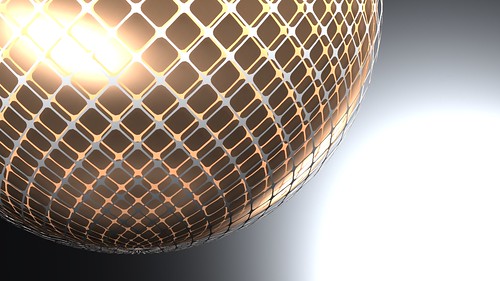
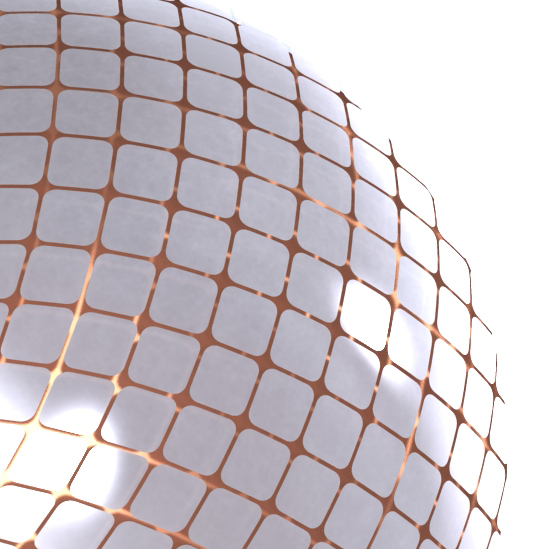
Here are some more pictures of the process:


 material over it several times. I then wanted to make a large piece of wall art out of my many pieces.
But how to color them? Should I? What kind of material should I use? I assumed that I would work with some kind of acrylic plastic, as this is the most common material used in the vacuum forming process, at least in the Industrial Design Department here at SCAD. I've done research into the different kinds of plastic available, and no quality of a single one stuck me as entirely right for this project. Nothing stood out in any way. Additionally, to cover a wall with acrylic would be entirely too expensive for me at this point in my artistic life.
Feeling somewhat discouraged, I headed to the Home Depot anyhow, thinking I could purchase a thin acrylic sheet of plastic, make a decently sized piece and spray it with a flocking gun, or just simple spray paint it. St some point the thought of doing a Pollock- esque action painting over it seemed as if it might be the answer, but clearly I was slightly losing my mind in the scramble for a solution.
Then I ran into some colleges who were working on a project for another class. One of them mentioned that you can vacuum form craft foam.
I made a mad dash to Michael's, and bought a large sheet of white, and every piece of royal blue craft foam they had to sell (only 36 in all, but the end product is larger than I had anticipated I could afford


 out of acrylic).
Once in Gulfstream, I tested the vacuum forming process with the white foam and a scrap piece of pink foam, and WOW! Every minute detail was picked up, and when you smash the material it remembers it's form and springs back to life! This discovery sold me on the material, and I began working on my piece.
As you can see, the material works beautifully on the pattern I created. The process is easy, you simply peal the foam off your finished product and reset it to vacuum form again. No agonizing about acrylic perman
 ently enc
 asing your mold, or splitting it in half during the forming process. Plus, it's cheap! When I do this next, I'm going to order the material in bulk, and get each sheet for 69 cents instead of 99. It would be completely affordable to create a pattern that covered an entire wall - and I'm already thinking about fine art as well as commercial applications. I could sell this to parents who want a fun nursery for their child, but don't want the permanence of paint or a wall sticker, and who would also appreciate having soft cushy walls. This is safe and fun, and the tactile nature of the material is good for a developing brain. As for a fine artapplication, you'll have to follow my blog, wait, and see!
Here are some more pictures of the process:


Sunday, November 15, 2009
John Adams: Exscind Complexity
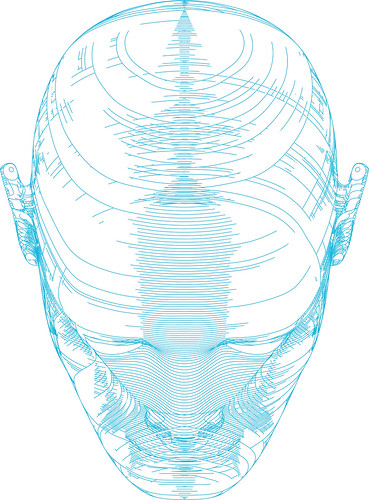
Exscind, meaning to cut or dissect, is a reference to the multiple layers of deconstruction of an 3-D object to to create a complex 2 dimensional image. Staring with a stock polygonal head model Maya was used to convert it to a poly surface nurbs model.

Then imported to Rhino the model was broken down further by contouring the model in an angled serial study. The relation of three dimensional lines in a two dimensional medium was the examined to find a two dimensional composition and transition of lines that could not been through a solid object.
Exporting this overlapping network of vector lines to Illustrator allowed the final step to creating the final image. Adding fill to all of lines from the poly surface nurbs created a overlap that covered some lines and bringing other forward.
This exploration process has given me insight into the potential of combining programs and the tools they offer. In the words of Professor Scott, "it doesn't matter what program because it's all in the file format". When thinking about the nature of different digital file formats, I have found it best to consider them as different mediums. Each have their own feel, potential, and limits in this was I would consider process mentioned above as an example of mixed digital medium.
Flickr Link
-John Adams
Janelle Wheelock: Digital Kiln Formed Glass


Once again we break new ground in our digital applications for sculpture. I thought I would share these images of Janelle's work after they completed their second slumping operation. During the first cycle we didn't take the kiln up high enough. The pieces did not slump completely. The second attempt was a lot more successful. The glass pieces slumped over the ludo molds perfectly. In this process she went from a computer model to a CNC milled wooden form that was then molded using Brush-On 40 urethane mold materials. The ludo was then cast into these molds. Now that is a Digital Application for Sculpture. I will let her talk more about it in her postings.
Headlight

 The profile image of the face was drawn using as a curve, in RHINO, rotated into a 360 degree vessel-like form. The Ribs holding the face image upright are cut from a secret script compliments of circles of friends of Prof. Scott. (Thanks for letting me carry on with lots of visual puns...)
ART and ENLIGHTENMENT
Here it is lit and on a table next to a crystal perfume container which belonged to my mother. Very fitting since the face-vase imagery comes to us from: Rubin's vase (sometimes known as the Rubin face or the Figure-ground vase) is a famous set of cognitive optical illusions developed around 1915 by the Danish psychologist Edgar Rubin.
Saturday, November 14, 2009


Tuesday, November 10, 2009
scpt250/450: playday

SCPT 250/450 PlayDay
Each quarter as an introduction to formatting files for laser cutting we channel our inner 6 year old and construct forms from modular units that have been cut on the laser. This quarter the theme was animals. As usual it was one of the highlights of the quarter.Sunday, November 8, 2009
BlackManGrove: Black Ice 1109

BlackManGrove: Black Ice 1109
Originally uploaded by afsart
An extension of an earlier work "Soul On Ice". In this work the form of the BlackManGrove is encased within a cubic framework. The Object within is revealed through the interior contours. I love that the three dimensional form is revealed within based on the light and the viewers location from the piece. The refraction and reflections of the light reveals the modeling of the form.
Tuesday, November 3, 2009
Stuctal lamp
Looking at the project constraint of using a single sheet of material to create a lighting piece a saw in interesting opportunity. In many contexts from commercial products to sculpture, material usage can be an afterthought. Wanting to waste the least amount of material as possible I decided to break down the 18"x32" laser cut bed into rectilinear shapes.

I then arranged them in a structural and nearly architectural composition, before cutting notches to assemble the lamp after it was cut. This exploration in developing a lit piece serve as a interesting exercise of deriving a sculptural form from responsible material use.
-John Adams


I then arranged them in a structural and nearly architectural composition, before cutting notches to assemble the lamp after it was cut. This exploration in developing a lit piece serve as a interesting exercise of deriving a sculptural form from responsible material use.
-John Adams

Monday, November 2, 2009
Project 3: Serial Forms
Project 3 is about learning to construct a form by dividing it up into serial planes. This form was created using the line tool to create a profile. Then, the revolve command was implemented to make a solid form (seen below on the left).
The section command broke up the mass into individual pieces (below on the right). A mathematical script was provided to calculate and add appropriate connections to the pieces allowing them to be fit together like puzzle pieces.
 Another script was applied after the piece was finished that placed each piece side-by-side. The pieces were then arranged in a grid 18x32 (the length of the laser bed) and color coded for the laser printer.


The section command broke up the mass into individual pieces (below on the right). A mathematical script was provided to calculate and add appropriate connections to the pieces allowing them to be fit together like puzzle pieces.
 Another script was applied after the piece was finished that placed each piece side-by-side. The pieces were then arranged in a grid 18x32 (the length of the laser bed) and color coded for the laser printer.

Alli Hall: From Binary to Bronze

Alli Hall SCAD Atlanta 10/23/09
Alli Hall continued her exploration of Digital Applications in Sculpture that she began during the summer of 2009. This fall she made a mold of her FDM model of her " Coral Sculpture" that was created during the summer quarter. Once completed, she created a wax positive that was sprued and gated for ceramic shell bronze castings. She had the pleasure of pouring the piece herself on October 23, at SCAD Atlanta. Here you can see her cutting away the sprues on her sculpture. Alli gets kudos for being the first SCAD student to cast bronze from an FDM model as a sculptural application.
[fab_lab]_SCAD: AuthorShape

[fab_lab]_SCAD: AuthorShape
Originally uploaded by afsart
Enlisting the help of photography majors, each member of Fab.Lab.SCAD was instructed to “paint” a fluid form using a light source in front of the open shutter of a digital camera, beginning and ending in the same position so as to ensure continuous author-shapes were created. The digital photos were randomized and presented to the group, where each member was then asked to pick a shape. Each photo was placed in Abobe Illustrator and live-traced, producing vectors that could be exported into Rhinoceros. These author-shapes were arranged in a random vertical sequence, removing individual identification and any resulting sense of hierarchy within the group. Using a loft command a seamless surface was created through a series of continuous curves between each author-shape. The resulting form derived from unity and balance represents the individual role in collective collaboration: the column.
Subscribe to:
Posts (Atom)


