Wednesday, October 26, 2011

Wednesday, October 19, 2011

3D Printing In Space

Found this video about making tools in space and thought it was super interesting. Now it's time for digital sculpture on the moon!

Thursday, October 6, 2011

nonLin/Lin Pavilion by Marc Fornes & THEVERYMANY


A wonderful inspiration from Marc Fornes & THEVERYMANY: nonLin/Lin Pavilion.


One of the latest ultimate design projects which is installed at the FRAC Center in Orleans, France. The architectural installation combines elements of biomimetic design – technology that mimics nature, architecture, sculpture and knowledge in what can only be described as an organic form. Fornes is the architect behind the New York-based design studio THEVERYMANY, and in the '''nonLin/Lin Pavilion'', Fornes experiments with dramatic changes of morphology; from the structural network to surface condition.


The nonLin/Lin Pavilion is the result of a very explicit research line, investigating the design and build component of a coherent environment. The self-supporting structure affects the users as it engages him/her to notions of limitation, filtration and spatial depth experimenting with illusion and space. The structure forms an eccentric universe where elements such as openings or dimensional measurements evolve from model or scale. In the pavilion, you cannot take the space for granted despite the fact that humans are able to perceive space from an infant state. The nonLin/Lin Pavilion, however, is one project that asks viewers to consider three dimensions as if for the very first time. This visual phenomenon is allowing spectators to suspend disbelief while assigning cultural references or analogies from nature (corals, flowers) – yet nonLin/Lin Pavilion is only a very precise experiment toward constructability within a precise economical and cultural context.

Thanks to Will Penny for providing the link to this project.

Tuesday, October 4, 2011

andrew f. scott: serial studies

Sometimes you have to be your own 5 axis miller. In this digital application for sculpture the fancy wires script which was written to produce waffle grillage structures has been adapted to output and label serial slices using a nurbs surface model.

Wind from the East

foon sham. Wind from the East. 1998. 97" x 56" x 60". Poplar, Oak, Maple

Serial slicing is a standard method used in the practice of sculpture to generate form.


In this combination of high-tech high touch approaches, the laser cut sections are glued up then carved to reveal the fluidity of the original nurbs model.

The models can then be finished using a wide variety of sculptural approaches. While it is nice to be able to fabricate forms such as these using the 5 axis mill it is often better to use traditional approaches because it gets around the butter-look signature of many objects created through the milling process. I think I may have discovered my love for wood carving.

Sunday, October 2, 2011

Will Penny - serial relief panels

KEYSHOT rendering of a geometric panel that has been modeled in RHINO and serially sliced to be laser cut and constructed into a wall-mountable relief.

The panel has been divided from its original solid form so that the alternating pieces may be used to create two panels. A flat base has also been modeled and divided to fill the gaps between the slices.


The first completed panel has been laser cut from thin plywood and finished with enamel paint.


The alternate pieces from the original model have been inverted from black to white to create the second panel.

Wednesday, September 28, 2011

Sam Titone serial cut/laser cut test


This was my first step into the world of Rhino and NURBS modeling. Make some simple stacked geometry's and your just a Loft away from a sleek sculpture.


A grasshopper script later and you have all your puzzle pieces...


Wednesday, August 31, 2011

Phases of the Face-Skull


For my quarter in Sculpture 250 used one clay model.
From this clay model I was able to create different variations through the application of digital tools.
Here are the different variations.


Milling


Serial Contour


Painted Serial Contour


FDM


Pepekura

Monday, August 29, 2011

andrew f. scott:Topmod Pepakura

topmod modeling and surfacing software was used to generate this model which was then processed for laser cutting using pepakura. I'd like to thank thank Kali Moon for your help assembling this model.
Friday, August 26, 2011

Kali Moon: Laser Cutting


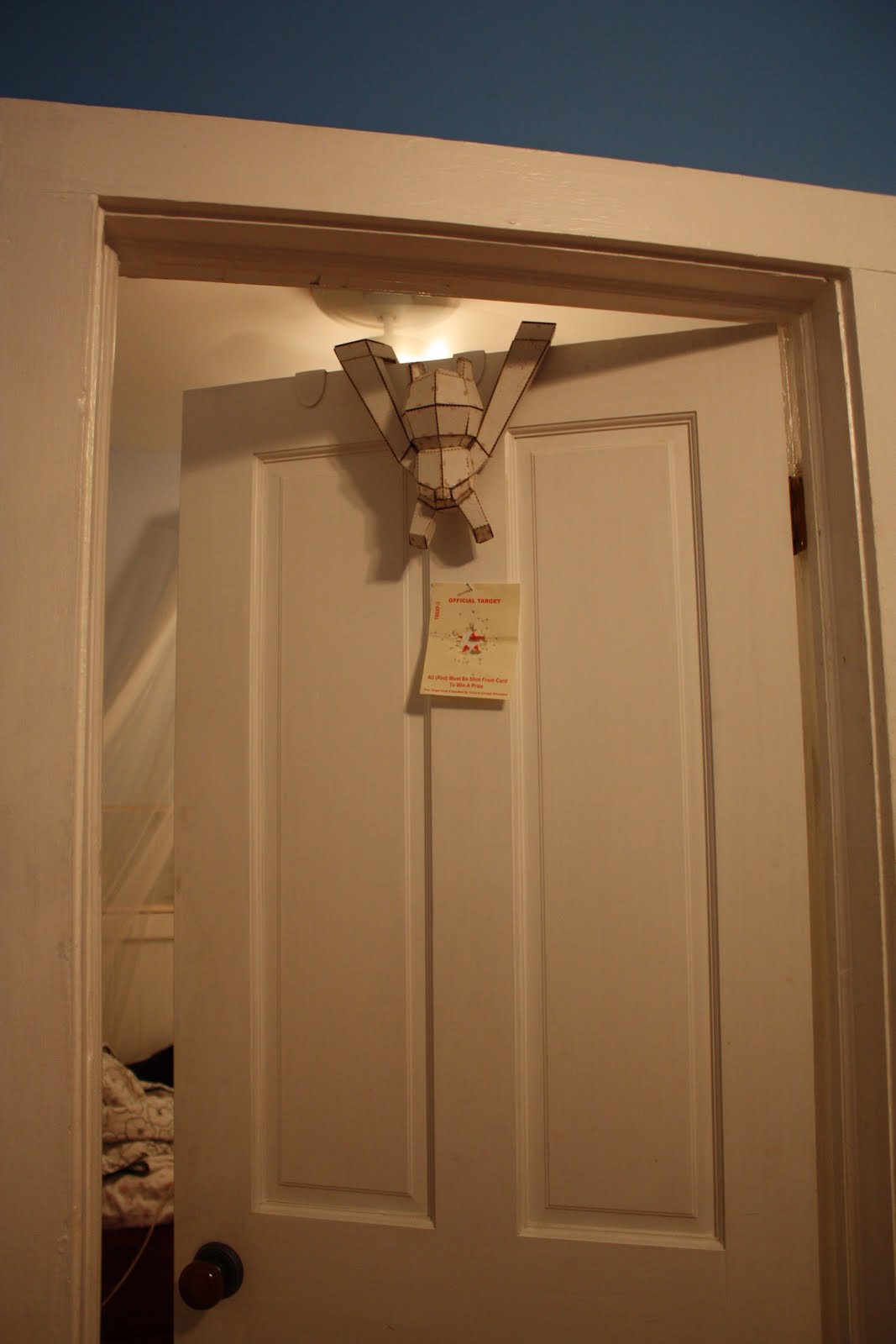
If you don't like to close the door, here's a good helper, Door Bear!
The bear is hung on the door to keep the door open.
After I created a door bear model in Maya, I used Pepakura Designer which is for making paper craft models from 3-dimensional data.
I exported pepakura model to .eps file, which is for getting join numbers, and .dxf file, which is for showing folding lines.
I followed the order to be ready to laser cut by using illustrator and Rhino.
I glued the same join numbers together
and I got Door Bear.

Saturday, August 13, 2011

Kali Moon: 3D Printing


I developed the face that I used for the first project in Zbrush, so that I have a detailed face. For this project, I want to describe a person who has various personalities, which are expressed by the different facial expressions on the balloon. The face which is blowing the balloon may describe cold-blooded personality with machine parts which seems like a very practical, precise and impulsive person.

Wednesday, August 10, 2011

andrew f. scott: mobius pepakura

One of two build outs from our recent lecture. The interesting aspect of this build in that each edge loop is built from a similar flat development which shows the expressive potential of mountain and valley folds. While building this I was also attracted to the interior forms, so I may create another one and reverse the mountain and valley folds to see how that comes out.

Sunday, July 24, 2011

Daniel Brookman: Barbie Ormolu, Intro

My work in this class will examine the role of the Barbie doll as an icon of popular American culture, exploring unexpected themes the Barbie brand can represent. The project will take the form of a desk that will feature ormolu mounts derived from Barbie iconography and other relevant imagery.

Ormolu comes from the French or moulu and means “powdered gold.” The term denotes a gold-colored alloy of copper, zinc, and sometimes tin, which is cast and then gilded. Ormolu was predominantly used in eighteenth century furniture decoration and timepiece construction.

Examples of ormolu.

Sketches of desk and components.

These sketches illustrate the French-inspired desk and ormolu components that I intend to create. The center of the desk will feature an asymmetrical medallion in mid-relief (top left), while each front corner of the desk will be adorned with high-relief figural mounts (top right). Along the back of the desk, a jungle scene will be rendered in low-relief and will span the width of the piece.

After initial sketching was complete, I purchased a basic Barbie doll to use as a starting point for my 3D model. The first step was to scan this, a process that was fairly straightforward: the doll’s head was isolated, the hair tied back and cropped, and a button-head machine screw was hot glued inside the neck cavity. The threaded end of the assembly was then screwed into the scanner platform until tight, which enabled a precise 3D scan.

3D laser scan in progress.

Three separate 360° scans were merged in this model.

NextEngine ScanStudio HD software was used to process the captured 3D data. This data was cleaned up in Rapid Works and then exported as an .IGS file for later use in 3D modeling software. Here is a quick KeyShot rendering of the unaltered .IGS file.

Scan data rendered in galvanized steel.

Daniel Brookman: Eye-Catching 3D Posters in East London


These paper posters were created by FOAM, a British agency that specializes in unique branded content for music artists and bands. The design began as a 3D model, which was then printed flat in component parts and hand-assembled.

Read more here on the "It's Nice That" blog.