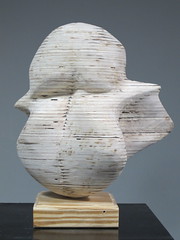
Tuesday, November 15, 2011

Will Penny - Laser Engraving Tests

The final engraving with craft balsa wood.

The six individual spheres were then modified in Illustrator for engraving.

Another set of engraving tests were created by manipulating a sphere in Maya, which was rendered out as a vector with only the frontal lines showing.

Detail of the raster engraving.

The engrave/cut was tested with both plywood and MDF, although the green engrave lines were somehow lost. The cause of this error has yet to be determined.

The design was began with a vector rendering of my FDM model converted into wireframe. Raster engraving and interior cuts designed in Adobe Illustrator were added to test multiple functions of the laser cutting machines.

Milling Tumors

Digital Tumors
Jake Ellis


The focus of my some of my past work has explored the union of technology and anatomy. Much like those pieces my goal with this project was to explore that interplay. Starting with an image of a brain tumor, I worked in illustrator and rhino to convert that image to curves and add depth. The piece was then milled and after making a mold, cast in Aqua Resin.

Image


Rhino


Render 1


Render 2

Milled Foam


Molding and Casting


Cast

I also took some tumors and laser engraved on wooden panels to further explore this idea.


3d Printing


3D Printing Exploration
Jake Ellis


This piece was an exploration in 3D printing. I was fascinated with removing the polygonal faces of forms and contorting them by rotating the CV's plane by plane. This was the result...


Maya File


Render

Render 2


Lazer Cutting

The Mind, The Cage
Jake Ellis


While exploring the serial slicing/laser cutting process, my goal was to create a piece that explored the dichotomy between the structural and the free and flowing. I often find that logic and reason incarcerate my emotional intuition and while quiet possibly that's a good thing, I can't help to wonder who I would be with out the cage that my experiences have created and which I exist in every day.


Rhino Model


Render 1


Render 2


Sunday, November 6, 2011

Will Penny - Milling

The painting process involves spraying three tints of red, yellow and blue from the sides of each panel. The colors are rotated on each panel to illustrate the varying possibilities for color mixing created by the obstructions of the relief.

Four completed panels 14" x 12" x 3" each.
Keyshot rendering of the intended panels. The closest material option within Keyshot to the painting process was a transparent prismatic material.

Completed panels after being sprayed with tinted acrylic gesso.

Four aqua-resin casts in various stages of development, cast from a silicone and plaster mold of the original milled panel.

For this assignment a simple geometric relief has been designed to test optical color mixing by way of paint spray shadows.

Saturday, November 5, 2011

Sam Titone, Mill project

For this Mill project, I decided to make what I tought could be a wall pannel. I started with a revolve loft that was meant to resemble ripples in water. I then distorted the "ripples" to make it look melted. I rendered this wall pannel in V-ray with a variety of materials ranging from tile and wood to translucent materials such as glass.


Wednesday, October 26, 2011

Wednesday, October 19, 2011

3D Printing In Space

Found this video about making tools in space and thought it was super interesting. Now it's time for digital sculpture on the moon!

Thursday, October 6, 2011

nonLin/Lin Pavilion by Marc Fornes & THEVERYMANY


A wonderful inspiration from Marc Fornes & THEVERYMANY: nonLin/Lin Pavilion.


One of the latest ultimate design projects which is installed at the FRAC Center in Orleans, France. The architectural installation combines elements of biomimetic design – technology that mimics nature, architecture, sculpture and knowledge in what can only be described as an organic form. Fornes is the architect behind the New York-based design studio THEVERYMANY, and in the '''nonLin/Lin Pavilion'', Fornes experiments with dramatic changes of morphology; from the structural network to surface condition.


The nonLin/Lin Pavilion is the result of a very explicit research line, investigating the design and build component of a coherent environment. The self-supporting structure affects the users as it engages him/her to notions of limitation, filtration and spatial depth experimenting with illusion and space. The structure forms an eccentric universe where elements such as openings or dimensional measurements evolve from model or scale. In the pavilion, you cannot take the space for granted despite the fact that humans are able to perceive space from an infant state. The nonLin/Lin Pavilion, however, is one project that asks viewers to consider three dimensions as if for the very first time. This visual phenomenon is allowing spectators to suspend disbelief while assigning cultural references or analogies from nature (corals, flowers) – yet nonLin/Lin Pavilion is only a very precise experiment toward constructability within a precise economical and cultural context.

Thanks to Will Penny for providing the link to this project.

Tuesday, October 4, 2011

andrew f. scott: serial studies

Sometimes you have to be your own 5 axis miller. In this digital application for sculpture the fancy wires script which was written to produce waffle grillage structures has been adapted to output and label serial slices using a nurbs surface model.

Wind from the East

foon sham. Wind from the East. 1998. 97" x 56" x 60". Poplar, Oak, Maple
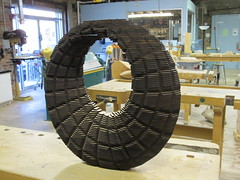
Serial slicing is a standard method used in the practice of sculpture to generate form.


In this combination of high-tech high touch approaches, the laser cut sections are glued up then carved to reveal the fluidity of the original nurbs model.

The models can then be finished using a wide variety of sculptural approaches. While it is nice to be able to fabricate forms such as these using the 5 axis mill it is often better to use traditional approaches because it gets around the butter-look signature of many objects created through the milling process. I think I may have discovered my love for wood carving.

Sunday, October 2, 2011

Will Penny - serial relief panels

KEYSHOT rendering of a geometric panel that has been modeled in RHINO and serially sliced to be laser cut and constructed into a wall-mountable relief.

The panel has been divided from its original solid form so that the alternating pieces may be used to create two panels. A flat base has also been modeled and divided to fill the gaps between the slices.


The first completed panel has been laser cut from thin plywood and finished with enamel paint.


The alternate pieces from the original model have been inverted from black to white to create the second panel.